Welcome to the first High Upside post of the 2015-16 season! [And only 4 months late.] One of the biggest narratives of the NBA season thus far [aside from Steph Curry's emergence as a demigod] has been NBA teams attempting to recreate the Warriors' success by playing "small-ball", and dramatically failing.
 |
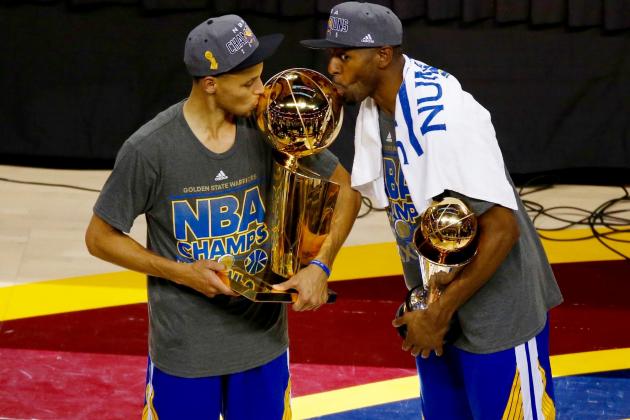
| GSW's title marked the mainstream emergence of small-ball |
During the 2015 NBA Finals, down 2-1 in games and having dropped the last two, head-coach Steve Kerr boldly replaced Center Andrew Bogut in the starting lineup with Small-Forward Andre
Igoudala. What followed came straight out of a fairytale. The Dubs won the next three games in a row and won the finals, while Igoudala took home series MVP honors.
As the saying goes, the NBA is a copycat league. Therefore, Kerr's shocking personnel change led other teams to question whether the two big-man system was antiquated and too slow. Journalists began to peg the Warriors and small-ball as prototypes for the next generation of basketball. Teams like the Indiana Pacers, Washington Wizards, and New Orleans Pelicans rebranded themselves as small-ball teams during the summer, in an attempt to emulate the success of Kerr and the Warriors. There's just one issue, all three of these teams failed to emulate the success of the Warriors and even failed to improve upon their own records from last season.
 |
Myles Turner's impressive start to the season allowed
Indiana to ditch small-ball and revert back to what they know |
It's not as though Pacers blatantly failed, but rather they weren't successful in drastically improving upon last season's record. Last year, they finished 38-44 and missed out on the playoffs, but they were missing Paul George for all but the last 10 games of the season, as he was recovering from a broken leg he suffered with Team USA. In George's last full season [2013-14], the Pacers went 56-26 and finished with the Eastern Conference #1 seed. Despite their massive roster overhaul which included bringing in notorious ball-hog Monta Ellis and ditching big-men Roy Hibbert and David West, the Pacers experienced more of the same to start the season. After beginning the season with a mediocre 23-22 record, Frank Vogel decided small-ball wasn't for him and inserted rookie big-man Myles Turner into the starting lineup, reverting back to the tried-and-trusted two big-man system. The early returns have been very encouraging, as he is averaging 13 points, 6 rebounds, and 1.9 blocks per game as a starter and was just announced Eastern Conference Rookie of the Month of February. Things are looking up for them now that they've ditched small-ball.
 |
John Wall and Co.'s underwhelming season have prompted
rumors stating HC Randy Wittman could be on his way out |
The failure of the Wizards has been slightly more pronounced than that of Indiana. While the Pacers have at least been able to [thus far] improve upon their performance last season, the Wizards are considerably worse than they were last season. They finished the regular season with a record of 46-36, they currently sit at 30-30 this season and are 1 game out of the playoff picture as it stands. The one thing the Wizards deserve to be applauded for is their persistence and strong will, as they're yet to ditch their pace-and-space style. However, as stubborn as Washington are to maintain their short system, the results don't justify it. While their offensive rating is slightly better than last season's [22nd last year to 18th this year], they were one of the league's top defensive forces last year [5th in defensive rating], but are merely a below average defensive team this year [17th]. They'll probably make the playoffs in a wide-open bottom half of the Eastern Conference, but it's unlikely they'll be anything more than bait for the Cavs or Raptors. It's a shame because things were really looking up for them following a nice campaign which saw them make the 2nd round of last year's playoffs.
Despite the lack of the success the Wizards have gained throughout their experiment, their failure dwarfs in comparison to that of the New Orleans Pelicans. Followed by an extremely encouraging 2014-15 season which saw them beat out the Thunder for the West's final spot, the Pelicans decided to rebrand themselves as a small-ball team, to free up room down low. The change in ideology has proven to destroy all momentum the Pels had built heading into the season. They're seven games out of the West's final playoff spot and have now reclaimed their spot among the most financially
 |
Davis's marvelous season has been overshadowed
by the incompetence of his teammates and the front office in NOLA |
troubled organizations. One of the worst parts of the Pelicans small-ball failure and regression, is that it's taken away from another fantastic Anthony Davis season. He's averaging virtually the same numbers he put up last year, while adding aa average three-point shot to his offensive repertoire. The Pelicans, much like the Wizards, seem intent on staying small, because Davis is their only traditional big man averaging over 17 minutes per game, so expect for of the same throughout the rest of the season. They say if it ain't broke don't fix it, and in typical Pelican/formerly Hornet fashion, the Pelicans broke it and now find themselves back in the Western Conference cellar with no hopes of competing, and $14 million owed to Eric Gordon.
Despite all the attention and praise its give, small-ball clearly shouldn't be emulated. Unless a team has the luxury of containing the best shooter in NBA history and the league's most versatile and unique player, it might be slightly difficult for them to emulate the massive success the Warriors have had with the system.
Thanks for reading


Hi Jack
ReplyDelete